Every rental owner wants the highest rent the market will support. A rent set a little too high, though, can cost more than it earns. Each week a home sits empty is a week of mortgage, taxes, insurance and utilities with no income to cover them. This guide walks through a practical way to price a rental in Central Florida so it attracts qualified applicants quickly, without leaving money on the table.

Start with signed leases and compare like with like
Asking prices show what owners hope to get. Signed leases show what tenants agreed to pay. When you research comparable rentals, give the most weight to leases that were actually executed, and treat active listings as context. A listing that has sat for six weeks tells you something too: it may be priced above what the market will bear.
A useful comparison matches the homes on these points:
- Property type: single-family, townhome, condo or duplex
- Bedroom and bath count: a 3/2 is not a 3/1
- Condition: updated flooring, kitchen and fixtures versus original finishes
- Parking: garage, carport, driveway or street
- Lease duration: a 12-month lease and a 6-month lease are priced differently
Local details matter as well. In Deltona, check whether the comparison home includes a garage, pool care or lawn service. A rent that covers pool service and landscaping is not the same product as a rent where the tenant handles both. In DeBary, avoid using a newer home with a garage and screened porch as a direct comparison for an older home without those features. Tenants notice the difference, and a rent that ignores it will draw few showings.
If you cannot find a close match, adjust. Note the difference, such as a missing garage or a smaller lot, and reduce the comparison rent by a reasonable amount. Write each adjustment down so you can explain your number later.
Subtract the cost of waiting
Many owners price against the highest figure they can imagine, then lower the rent slowly if nothing happens. That approach has a hidden cost, because vacancy is lost income you cannot recover.
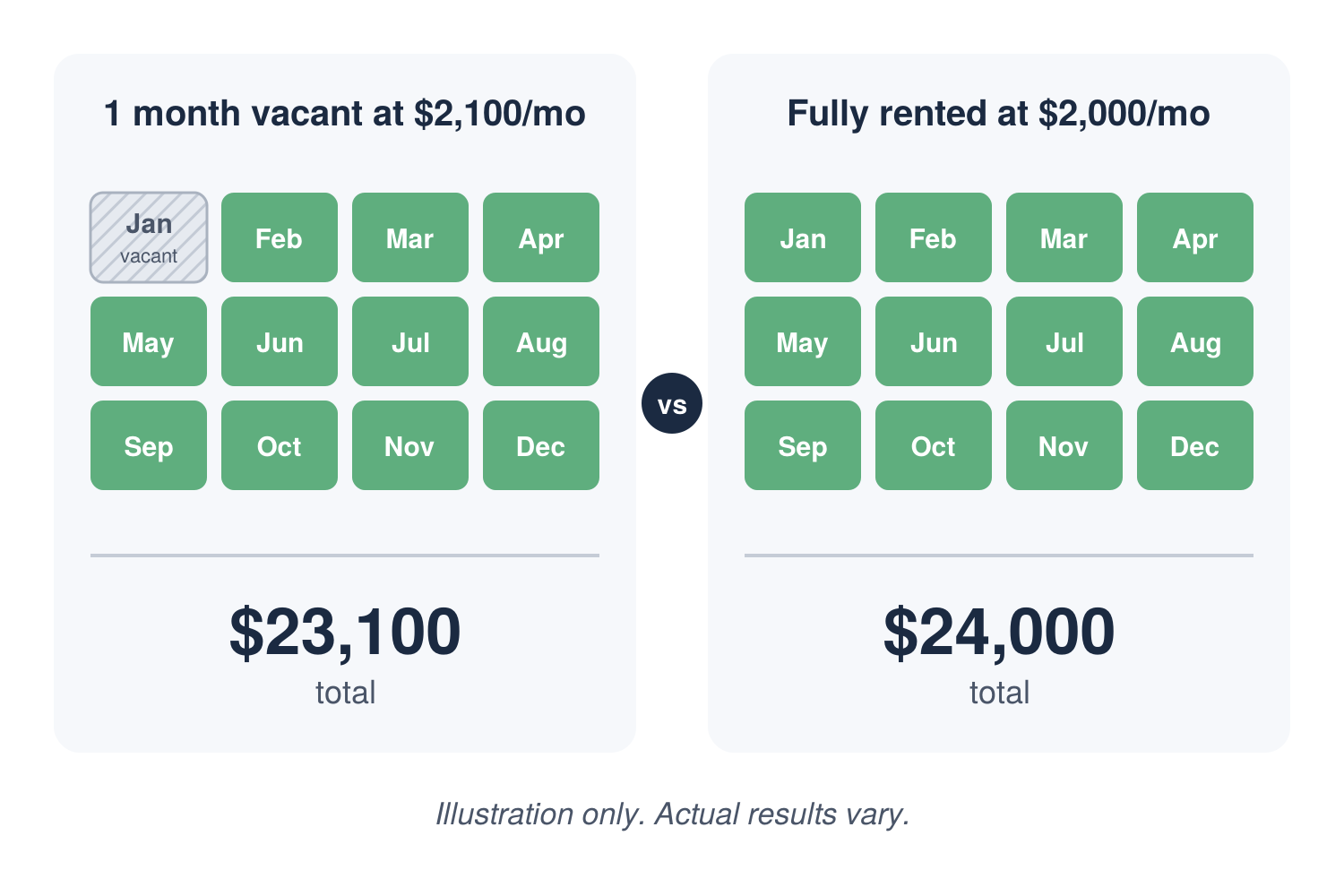
Here is an illustration. A home advertised at $2,100 sits vacant for one month, then rents for the remaining 11 months. Over 12 months it produces $23,100 in gross rent. A home advertised at $2,000 that rents for all 12 months produces $24,000. The lower-priced home earns $900 more over the year, even though its monthly rent is $100 lower.
Both numbers are illustrations, not predictions. They show how quickly extra vacancy can outweigh a higher asking rent. The $2,100 home would need to be occupied for roughly 11.4 months to match the $24,000 total, which means vacancy has to stay under about two and a half weeks for the higher rent to win. Even a short delay changes the result.
Vacancy also brings costs beyond lost rent. Utilities, lawn care and pool service continue while the home is empty, and the owner carries the payment. A longer listing can also make a home look stale to applicants who wonder why it has not rented.
Prep the home and agree on how to read results
Pricing works best when the home is ready to show on the day the listing goes live. Put repairs, cleaning, photography and showing access on the same calendar, and finish them before the first inquiry arrives. A home that is advertised before it is ready loses its strongest week of attention.
Before listing, confirm these items:
- Repairs are complete and the home is professionally cleaned
- Lawn and exterior are presentable
- Photos are taken in good light and show every room
- A lockbox or showing system is in place, with flexible hours
- The listing states the lease terms, pet policy and what the rent includes
Decide in advance how you will interpret the results. Track the first week of qualified inquiries, showings and application activity, and compare them against what you expected.
- Many inquiries but few tours: check showing access and listing accuracy. Prospects may be unable to schedule a visit, or the photos and description may not match what they find.
- Many tours but no applications: examine condition, price and lease terms. Applicants who see the home and walk away are usually reacting to one of those three.
- Few inquiries: review the price against recent signed leases and the quality of the photos and headline.
Having this framework before you list keeps the decision about a price change grounded in data, not worry.
Use a range tied to your goals
A single number rarely captures what a home can rent for. A range is more useful. Ask whoever prepares your rental evaluation, whether a broker, property manager or your own research, to explain what supports the low, middle and high end of the range, and which figure fits your timeline.
For example, the high end may assume a longer marketing period and a small number of ideal applicants. The middle may reflect typical activity for similar homes. The low end may suit an owner who needs the home occupied by a specific date. None of these is wrong. The right choice depends on whether you value a higher monthly rent or a faster start date.
If the rent includes valuable services, such as lawn care, pool service or a garage, put that in front of the applicant so they can compare the full monthly cost. A tenant weighing a $2,000 rent with pool and lawn service against a $1,900 rent where they pay for both may find the first option less expensive overall. Stating this clearly in the listing helps the right applicants see the value.
Putting it together
A sound rental price rests on four habits: compare against signed leases and matching features, weigh the cost of vacancy against a higher asking rent, prepare the home before listing, and read early results against a plan. Used together, they help owners fill a home on a reasonable timeline at a rent that reflects its condition and location.
Every property and market moves differently, so a local evaluation will always be more precise than a general guide. If you are preparing to rent a home in DeBary, Deltona or elsewhere in Central Florida, a review of recent comparable leases is a sensible first step.
Figures in this article are illustrations and do not guarantee any rental outcome.
Request a free rental evaluation